
The stages of IVF, from first visit to pregnancy test
A step-by-step walk through an IVF cycle, so you know what happens, when, and how long each stage takes.
Charitos BO Hospital8 min read
In short
- From the first injection to the pregnancy test, a cycle usually takes about a month, plus the tests beforehand.
- Stimulation means around 10 to 12 days of daily injections, with scans to track your follicles.
- Egg collection is a short day-case procedure under sedation; you go home the same day.
- The pregnancy test is a blood test two weeks after embryo transfer.

1. Before you start: consultation and tests
Your first consultation reviews both partners’ history and plans the tests your cycle needs. These usually include a hormone profile, a pelvic scan, a check of the fallopian tubes and a semen analysis. Most can be done here, though some are timed to your menstrual cycle, so they usually take two or three visits over about a month. Screening for infections such as HIV and hepatitis is also standard before treatment.
IVF can help when the fallopian tubes are blocked or damaged, when ovulation is a problem, with endometriosis, when sperm counts or quality are low, when no cause has been found after trying for a long time, and when simpler treatments such as IUI have not worked. Read more about the fertility assessment.
2. Stimulation
Normally your ovaries release one egg a month. IVF uses hormone injections, usually follicle-stimulating hormone (FSH), to grow several follicles at once, because not every egg will fertilise or develop. You take daily injections for around ten to twelve days, with other medicines to stop you ovulating too early.
Regular vaginal ultrasound scans, and sometimes blood tests, track how your follicles grow, so doses can be adjusted. When enough follicles are ready, a final "trigger" injection matures the eggs, and egg collection is timed for about 34 to 36 hours later.
3. Egg collection
Egg collection is a short day-case procedure under sedation, and you go home the same day. Guided by an ultrasound probe, a fine needle is passed through the vaginal wall into each follicle and the fluid containing the egg is drawn off. It usually takes about 20 minutes. Period-like cramping afterwards is normal.
On the same morning, your partner gives a semen sample, or frozen or donor sperm is prepared.
4. Fertilisation and embryo culture
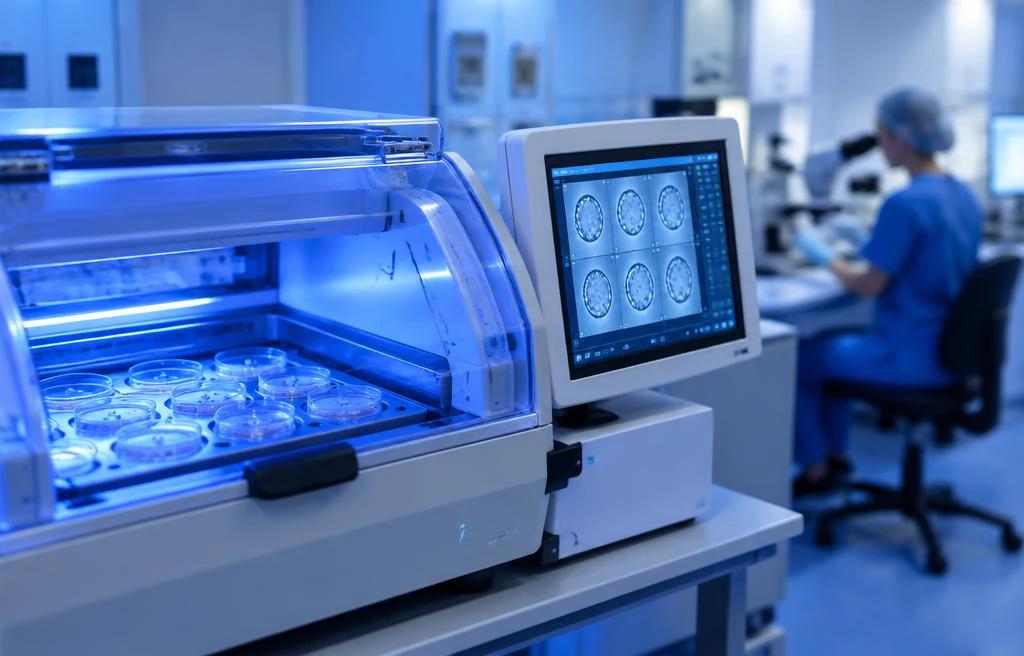
In our in-house embryology laboratory, eggs and sperm are brought together. In conventional IVF, sperm are placed with each egg. With ICSI, a single sperm is injected into each mature egg — the usual choice when sperm quality is low or eggs have failed to fertilise before.
The next day the embryologist checks which eggs have fertilised. Embryos are then grown in the laboratory for three to five days; by day five the strongest may have reached the blastocyst stage.
5. Embryo transfer
The best embryo is placed in your womb through a thin, soft tube passed through the cervix, usually guided by ultrasound. It feels much like a smear test and does not need an anaesthetic. Spare good-quality embryos can be frozen for a later frozen embryo transfer.
6. The two-week wait
You can go back to your usual daily activities; resting in bed does not improve the chance of success. Progesterone, usually as pessaries, gel or injections, supports the lining of the womb.
For many people the wait is the hardest part. If you are struggling, talk to us — you do not have to wait alone.
7. Pregnancy test and next steps
A blood test two weeks after transfer shows whether you are pregnant. Either way, we sit down with you to plan what comes next: an early pregnancy scan and antenatal care if the test is positive, or a review of the cycle and your options if it is not.
What IVF costs here
Our low-cost IVF package is ₦1.35M for one cycle, all-inclusive: it covers the IVF drugs, the technical fee and the laboratory investigations. Donor eggs or sperm, genetic testing of embryos, surrogacy and fertility surgery are not included, and two- or three-cycle plans are discussed directly with our fertility specialist. See what the package covers.
Common questions
How many cycles of IVF will I need?
Some people conceive in their first cycle; others need more than one. The chance of success depends most on the woman’s age and the cause of infertility. After each cycle, your consultant reviews what happened and whether to change the plan.
Is egg collection painful?
It is done under sedation, so most women feel little during the procedure. Afterwards, period-like cramps and light spotting for a day or two are common.
Can I keep working during IVF?
Most people work through stimulation and fit their scans around the day. Plan to take the day of egg collection off, and perhaps the day after.
Sources and further reading
- In vitro fertilisation (IVF) (opens in a new tab)Human Fertilisation and Embryology Authority (UK)
- IVF (opens in a new tab)NHS
- Risks of fertility treatment (opens in a new tab)Human Fertilisation and Embryology Authority (UK)
This article is general guidance, not medical advice. Whether a treatment suits you, and what it is likely to achieve, can only be assessed by a clinician who knows your history. If you are worried about your health, please call us.


